Showing posts with label ramen. Show all posts

Friday, March 1, 2013

Yume Wo Katare

_DSC1127.jpg
Call me a chicken or call me lame.

Or maybe I'm just not a quite as devoted a ramen fan.

Sure, I'd been curious about Yume Wo Katare even before it opened. Who wouldn't be intrigued by the promise of authentic ramen from Japan, complete with thick, handmade noodles and a rich, flavorful broth?

But then there were the lines. The infamous lines that stretched down the block, especially on weekends. It wan't unusual to wait 2 hours for a bowl of noodles. Of course, from what I heard, the brave souls who waited in these long lines were rewarded with a phenomenal bowl of noodles. Those that were lucky bragged about "only" waiting 20-30 minutes. Those in the know advised going right at 5:00 pm (about an hour before they open).

"Usually they'll open the doors around 5:30 and start letting people in. This way, you only wait 30 minutes."

I live less than a 15 minute walk away from this place, yet I couldn't bring myself to go try it. The uncertainty of potentially having to wait in line for up to two hours most definitely deterred me, big time.
_DSC1109.jpg

A few nights ago, Bryan informed me that he was going to be late coming back from work. It seemed like the perfect opportunity to try to catch this elusive place at a time when possibly, just possibly the line might be shorter.

We decided to take the chance. It was a reasonably "warm" night out (hey, if it's above freezing here in Boston, we think it's warm), and we were OK going to another backup place in Porter Square if necessary.

Surprisingly, at around 8:30PM, there was no line out the door. Instead, we walked inside, paid for our noodles at the counter, and stood along the wall of the restaurant . . . . waiting. Waiting and watching sixteen other hungry people slurp down their noodles.

Shockingly, within 5 minutes, 4 people finished their noodles and got up to leave.

We couldn't believe it.

We were finally in.
_DSC1123.jpg
Yume Wo Katare opened in Porter Square (Cambridge) in October of 2012. Chef-owner Tsuyoshi Nishioka has five other ramen restaurants in Japan and decided he wanted to open one up in the US.

It took him awhile to find the perfect location. He tried out a bunch of places, including Hawaii and New York, before settling on Boston. He was searching for a place where there were lots of students - people who didn't have that much money but had huge dreams.

Tell me your Dreams. "Yume" means dreams in Japanese, and "Katare" is tell. 
_DSC1107.jpg
The tiny restaurant is covered with colorful framed signs describing different people's dreams. You can pay $10 to display your dream for a month; $30 for 3 months; all the way up to $10,000 for 10 years (would that guarantee that he would stay open in that location for 10 years? - perhaps "until 2030" like the sign promises?).
_DSC1111.jpg
Chef Nishioka is passionate about his ramen. He wakes up early each morning and spends two hours making the noodles by hand.

I asked, "muzukashii desu ka?" (isn't that difficult?)

He smiled and replied (in Japanese), "I have been doing this for ten years. I made ramen for ten years in Japan, so now it is not so difficult."

The pork bone "tonkotsu" broth (not to be confused with the breaded pork cutlet called "tonkatsu") is simmered gently for over 24 hours, never allowed to actually boil. What results is this thick, rich broth full of collagen, pork fat, and tons of flavor. Some liken it to a light gravy almost.
_DSC1126.jpg
The restaurant specializes in one dish and one dish only: Jiro-style pork ramen. This style of ramen typically comes with thicker noodles (made from higher gluten bread flour), chashu pork and belly, and a thick, fatty pork bone broth. A pile of lightly blanched cabbage and fresh bean sprouts feebly attempts to balance out all that porky richness.

This unusual style of ramen (which some ramen purists refuse to acknowledge as ramen) started in Mita near Keio University at a place called Ramen Jiro. The gargantuan portions of noodles and pork became a hit with students who were looking for delicious, hearty food at a good value.

Especially popular with young college males, it soon became a lauded feat if one could polish off the entire bowl of noodles in its entirety - every single thick slice of fatty pork, the huge pile of dense noodles, the gobs of fresh garlic, and that ultra rich broth. It became a bragging right in and of itself.

Since then it has gained a cult following in Japan, spawning off over 30 other branches across Tokyo alone.
_DSC1117.jpgBryan's bowl with extra vegetables and 5 slices of pork

At Yume Wo Katare, the choices are simple:

First, do you want 2 slices of pork ($12) or 5 slices of pork ($15)?

Second, right before serving you the noodles, the chef will ask you:

Ninniku iremasuka? (do you want garlic?)

I would highly recommend it, as the pungent, raw garlic really helps cut the rich fattiness of the pork belly and the broth. Some would even argue that it's not true Jiro style ramen without the garlic. It definitely offers the needed balance. Of course, be prepared to smell like garlic the rest of the night, because you get a lot!

Don't worry if you can't remember all this. There is a HUGE sign that explains exactly what the chef will ask you. At the end of the day, you just have to decide whether you want garlic or not.
_DSC1118.jpg
Jen's bowl with 2 slices of pork


If you want to be authentic, you reply with "hai!" (pronounced "hi"). Of course, he understands a tiny bit of English. Bryan was so taken aback by the rapid Japanese that came out of Chef Nishioka's mouth that he just sort of looked confused and said, "I'm sorry, I don't speak . . ."

Chef Nishioka kindly repeated in English, "garlic. do you want garlic?"

You can also ask for extra vegetables, which Bryan did. It means you get a much bigger pile of the blanched cabbage and bean sprouts. Extra pork fat is the last option, but neither of us asked for it, since we already thought the soup had plenty of fat.
_DSC1120.jpg
How does it taste?
It's is definitely different from any other ramen you can get in Boston.

The broth is deep, rich, intensely flavorful, and also quite fatty. It's very soul-warming on an icy cold day. I can just imagine how satisfying this bowl of soup would be for someone who has been standing out in the cold for two hours, starving.

The pork belly is lusciously melt-in-your-mouth soft and very flavorful. One of my pieces had less fat (perhaps it was pork shoulder?) and was just a bit tougher than the round slices of pork belly. I guess it depends on which pieces you get. The vegetables are fine - simply blanched, they are probably there more for texture than flavor. This dish is seriously all about the pork.

And the handmade noodles are great. Bryan especially liked that part.

"These are better than the noodles at Ippudo," he said.
_DSC1112.jpg
Some may think Chef Nishioka is a ramen nazi of sorts. After all, there are many rules by which you must play if you want to eat here.

First of all, he only speaks Japanese. I almost felt like I was in Japan as I stepped into this little place - everything from the traditional "irasshaimase!" (welcome) that's yelled out right when you enter to the use of various Japanese phrases used throughout (like the garlic one).

Second, the place is cash only and they aren't shy about (gently) kicking you out of your seat if you're done. After all, there's almost always a huge line outside, and they try their best to move things along. We must have hit a lull, because by the time we left around 9PM, the line had started growing again.

Finally, everyone over the age of 12 must order a bowl of noodles - no sharing (even though the portion is huge!). They don't do take-out, and you can't take any leftovers home with you.

This rule was the hardest for me. On the one hand I felt terrible about throwing away so much of his labor-intensive handmade noodles and 24-hour broth. On the other hand, the idea of eating that entire bowl of pork belly, fat, and thick noodles just made me feel a bit sick. I was seriously stuffed even after eating just about half the bowl.
_DSC1124.jpg
It looks like I didn't even make a dent, but this is what I had to leave behind.

Thankfully, Bryan did eat some of my noodles afterwards. I was seriously impressed with Bryan. Not only did he finish his own entire bowl (which was the bigger one with five pieces of pork), he made a sizable dent in my bowl of noodles.

At Yume Wo Katare, the chef will personally say "good job!" to you if you are able to finish your entire bowl.
_DSC1122.jpg
Is it worth the hype?

Wow, that's a hard question.

The dish, as a whole, is very good with excellent execution on all fronts. The ramen broth is richly flavorful and the pork belly is luxuriously soft and tender. It's hard to get handmade noodles in Boston, so we really appreciate the care and dedication that Chef Nishioka puts into making them every morning. They have a decent "Q" to them, though I would still classify them as soft noodles.

This is the type of ramen that's hard to eat on a regular basis. It's just so rich and heavy, you're really kind of wiped out by the time you finish a meal here. Forget about trying to get some work done. Just go straight to bed with your pork-fat induced food coma.

I do love the concept of this place, and I liked being there. It transported me back to Japan, which made me very happy. In my own perfect world, I would be able to order a smaller portion size or take home leftovers. I wouldn't mind a wider variety of vegetables, and Bryan was sort of wishing for some hot sauce.
_DSC1109.jpg
Of course, these are matters of preference, and it's more of a reflection of our personal opinions on Jiro-style ramen than on Chef Nishioka himself. Personally, I think Chef Nishioka is doing a fantastic job, something that is clearly, clearly evidenced by the popularity of this place.

Chef Nishioka will be going back to Japan for about a month (between April 7 and May 6th), during which time Yume Wo Katare will be closed. Update! He has postponed his trip. So you can still go get noodles!

If you want to get a taste of that ramen, I'd suggest trying to go in the next month or so when the colder weather is still a bit of a deterrent for some. Otherwise, if you try to come back after May, you may be faced with those scary 90-120 minute waits again.

I love the fact that more and more Japanese places are opening up around Porter.

Seriously, perhaps I'll have to consider buying a 10-year "dream" just so he won't leave the area anytime soon.

Yume Wo Katare
(Porter Square)
1923 Massachusetts Ave
Cambridge, MA
Yume Wo Katare on Urbanspoon

Sources: Ramen Tokyo Rameniac NYTimes CNN

Saturday, January 12, 2013

"Homemade" Rokurinsha Ramen (Tsukemen)

Untitled
When asked by Eater Boston to "describe 2012 in one word" as part of the Friends of Eater interview series, my answer was simple: ramen. 

Ramen has taken Boston by the storm. Ever since Guchi's Midnight Ramen made its debut just under a year ago, (wow, has it only been a year?), various restaurant have started serving ramen to try to meet the serious hunger for this dish. Yume wo Katare just opened at the end of 2012, and still boasts lines that average an hour or more. Uni Sashimi Bar started serving midnight ramen, as did Myers + Chang, Pigalle, and even Strip T's.

Though I've been to Japan countless times, I've mostly focused on sushi during my previous visits, and thus am woefully a noob when it comes to ramen.

My last visit to Japan I finally had a chance to see what the hype was about in Japan (where people have been lining up to eat good ramen for decades). I visited Rokurinsha, one of the most popular ramen places in Tokyo.

This post is not about Rokurinsha. You can read all about that experience here.

Instead, this post is about their "ramen kit" that I bought at the store. It's about how that one package of their specialty ramen kit catapulted me onto this crazy cooking journey where I ended up using both a sous vide machine as well as a pressure cooker in order to execute this "packaged" ramen.

Definitely one of the most time-consuming and elaborate "instant" meals I've ever made.
Untitled
Rokurinsha sells ramen kits and vacuum sealed roasted pork right at the restaurant. That way, if you want to make their ramen at home, you can make a pretty good approximation. Since I was bringing this back to the U.S., I knew I couldn't bring the packaged pork. However, I did buy one package of the ramen kit so that Bryan could try it.
Untitled
In Japan, it's not unusual to find "half-dried" noodles in the market. They aren't exactly fresh noodles, but they aren't quite completely dried either. I find these noodles to taste more al dente and chewy than traditional fully dried noodles. They typically have a shelf life of about 1-2 months, so you do need to cook them soon after you purchase them. They do dry out.
Untitled
The Rokurinsha package came with these half-dried noodles, which I cooked for about 10 minutes in boiling water.
Untitled
It's gorgeously al dente, and I would highly recommend that you pick some up if you are in Japan.
Untitled
The soup base part of it was pretty straightfoward. Although the instructions were purely in Japanese, I was able to use a combination of the pictures, my crude knowledge of Japanese, and my medium knowledge of Chinese characters in order to figure out what the instructions said.
Untitled
But it can't be that easy, can it?

Of course not! It wouldn't be on this blog if it were that straightforward. In order to bring this "instant" dish up several notches, the first thing I decided to do was to add a sous vide "onsen" egg. Onsen literally means "hot springs" in Japanese, and refers to these barely cooked eggs which still have a slightly gelatinous yolk. They are decadent and easily made in a sous vide machine.
Untitled
Just dial the sous vide machine to around 63 °C (146 ° F) and cook for about 45 minutes (in the shell). Crack open the shell (just once using a sharp jab with a fork), and break open, releasing the velvety egg right into the soup.
Untitled
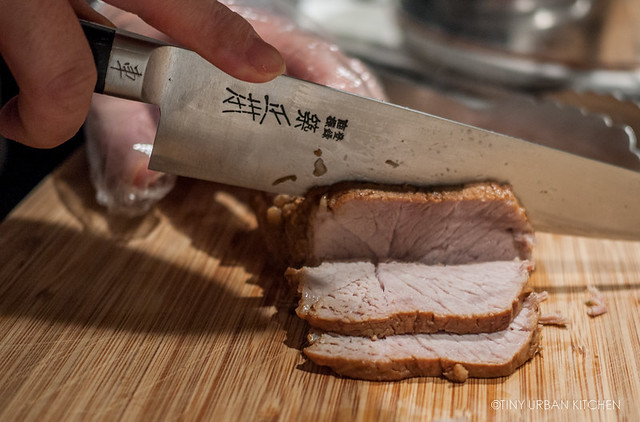
I also made chashu pork shoulder using my nifty new pressure cooker, which resulted in beautiful, tender meat after cooking for only about 1-2 hours. Please click here for the recipe.
Untitled
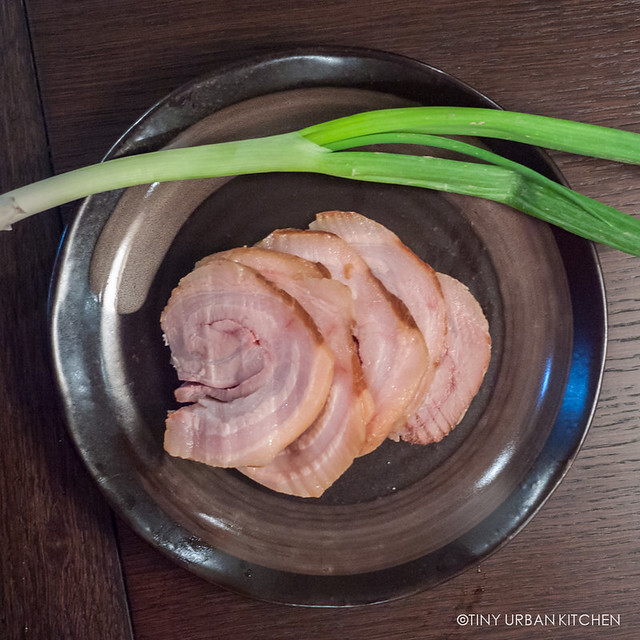
Finally, inspired by multiple sources, I decided to make 48-hour sous vide pork belly. According to the Modernist Cuisine at Home, pork belly can be cooked sous vide within a number of different temperature ranges and time (anything from 12 hours to 48 hours!) The resulting pork belly was gorgeously soft and tender, infused with soy, aromatics, and spices. Please click here for the recipe.
Untitled
For an "instant" dish, this entire bowl of ramen took me three days to compete. There was a heck of a lot of planning, and (of course), lots of waiting.

The final product was awesome. Of course, we all know that the broth is the most important part, and in this case, I "cheated" because the broth was provided by one of the most famous ramen shops in Tokyo. However, having insanely tender pork belly, super soft and flavorful pork shoulder, and a luxuriously velvety egg didn't hurt one bit.
Untitled

Thursday, January 10, 2013

Chashu Pork Roast (pressure cooker)

Untitled
This post is a part of a larger post about making ramen using a kit from the famous ramen shop in Tokyo, Rokurinsha.

I hope this doesn't get old too soon, but I'm having so much fun with my new pressure cooker.

I'm still floored by the idea that something that should take hours to cook can be finished in 1/3 the time, just because it's cooked under a higher pressure (and thus a higher temperature).
Untitled
I decided to make braised chasu pork as one of several components of my super complicated "instant" ramen from Rokurinsha in Tokyo. I was already cooking the pork belly sous vide for 36 hours; why not go all out and try to cook the pork roast in a pressure cooker?

I had actually originally planned on making pork shoulder. Unfortunately, the normal American supermarket that I visited didn't have any, so I had to settle for "pork roast", which is leaner than shoulder (or butt), and therefore, harder to make super soft and tender.

Nevertheless, the pressure cooker performed gorgeously.  I stopped by a grocery store on my way home from work; picked up some pork roast; and managed to cook the meat in an hour for our ramen dinner.

Untitled
The recipe is pretty simple, actually. Gather up your typical Asian aromatic (onions, ginger, garlic, and scallions).
Untitled
Briefly brown the pork roast until a nice, brown surface forms on both sides.
Untitled
Add your aromatics.
Untitled
Then add all the lovely flavoring liquids, such as soy sauce, mirin, sake, and water. Cook under pressure for about 1 hour (minimum), and 2 hours for insanely soft results.

We did eat a portion of it after it had cooked for one hour. We left the rest of it in the pressure cooker and continued to cook it for another hour. After two hours, even the super lean pork roast was meltingly tender.

I'm guessing if you used pork shoulder/butt (which is higher in fat content), you won't need to cook it for as long as I cooked the pork roast.

Assemble, and enjoy!
Untitled

Chashu Pork Roast
2 lbs pork shoulder
200 mL soy sauce
200 mL sake
200 mL water
100 mL mirin
5 tablespoons sugar
2 stalked of scallions
5 cloves of garlic
2 inch knob of ginger

Sear pork shoulder on all sides in pressure pot. Add liquids and aromatics. Cook until sugar is melted. Cover and wait until pressure reaches 4 bars. Cook for 2 hours. Cool and slice.

Saturday, December 8, 2012

Rokurinsha (tsukemen ramen)

Untitled
This is the second post in the series titled Tasting Tour of Tokyo detailing my recent trip to Japan. Other posts include Kikunoi Akasaka.

How do you find a good ramen place in Japan?

Easy - just look for the place with the longest lines. Japanese people absolutely adore their ramen and are very willing to patiently wait in long, organized lines in order to partake in this soul-satisfying hot bowl of noodles.

A perfect example would be Rokurinsha, a ramen shop that opened in 2005 in a quiet residential area in the Osaki district of Tokyo. Although it was a bit out of the way, the place was always packed, filled with lines that sometimes reached over 300 people on busy weekends. It was not unusual to show up at 11AM and wait about two hours before getting into the tiny 12-seater dining area.

Eventually in 2010, under much pressure from angry residential neighbors complaining about the crazy lines, Rokurisha closed its Osaki shop and re-opened elsewhere in the city.

The location most people talk about is the one inside Tokyo Station on Tokyo Ramen Street, a corridor full of ramen shops all in a row. A second one resides at the shopping complex at the Tokyo Sky Tree, Tokyo's newest attraction (and the tallest tower in the world).
Untitled
The Tokyo Sky Tree is very, very tall and opened up to the public on May of 2012. The opening was so highly anticipated that some people waited in line for a week to get first dibs on tickets. Even now, it is quite popular with both tourists and locals alike. In fact, I waited over an hour in line before getting onto the uber fast elevator to the observatory.
Untitled
It's quite fun to see Tokyo from such a height. I saw parts of the city I had never seen before (what is that cool area with all that water??)
Untitled On a clear day, you can see many of the surrounding mountains, including Mt. Fuji.
Untitled
If you're not afraid of heights, you can step onto the glass floor area and look all the way down. It's quite something!
Untitled
Afterwards, you can head on over to Rokurinsha. Take the elevator back down and head over to the 6th floor of "Solamachi", the new shopping complex that's connected to Tokyo Sky Tree. Yes, there will be a line, of course (it wraps around the entire restaurant). What do you expect?

At least they have chairs for the people who have waited in line for quite awhile. Once you get to the chairs section, you also get a copy of the menu to peruse.
Untitled
You have to purchase your "tickets" for the ramen before you enter the restaurant. The prices are quite reasonable, with most bowls being somewhere around 850-1050 yen range (about $10-$12 US).
Untitled
After about an hour, we were finally seated! We had awesome seats at the bar, which was great. It was fun watching the chefs making the ramen right behind the counter.
Untitled
They give you bibs because they think it's so messy!

After all, Rokurinsha specializes in tsukemen, or dipping noodles. You get your noodles and broth separately, and then you just dip the noodles into the soup. This explains why you may sometimes make a mess.
Untitled
I'm not sure if the noodles were freshly made on site (perhaps not), but the texture was still excellent. They were super thick, very chewy, and really fun to eat.
Untitled
But the star of the show was the gorgeously thick broth. I really think it was one of the best bowls of ramen I'd ever had in my life. The tonkotsu (pork bone) and dried fish based broth is stewed for over 13 hours. This results in a deeply flavorful broth that's brimming with umami. The bonito flakes on top add even more umami, making the entire soup oh-so-satisfying to eat.
Untitled
The egg is boiled just the right amount to retain that soft, almost gelatinous center. Here I've dipped some of my noodles into my broth.

It was a fantastic meal. Because I had waited in multiple lines by lunchtime (both at the Sky Tree and then in the ramen restaurant line), I was famished by the time these noodles were laid in front of me. I was happy about the bib, as I'm sure I splashed some broth around in my attempts at dipping the noodles.

By the way, it's perfectly OK to making slurping sounds while eating your noodles in Japan. In fact, you should slurp. It shows that you are really enjoying your noodles.  It's almost more rude not to slurp, since the chef may think you don't like the noodles.

So slurp away!
Untitled
I was thrilled to discover that they sold takeaway packs for Rokurinsha ramen at home. Definitely not cheap at around $15 a pack (serves two people I believe), I bought one to take back with me to the US so that Bryan could try it too. Unfortunately, I could not buy the pork that they sold (no meat products!), but I'm really excited to try their packaged noodles + dried soup base to see how good it is!
Untitled
In short, I cannot recommend this place highly enough . Granted, I haven't tried that many ramen places in Tokyo (after all, I've been focusing on sushi for quite sometime my past few trips). However, the rest of Tokyo seems to be vouching for this place as well, evidenced by the insane lines at all of its branches. Is it any surprise that the branch of Rokurinsha at Tokyo Ramen Street always has the longest line?

Definitely check out this place if you're visiting Tokyo. It's worth the wait. I promise.

Reminder - today's the last day to enter the Radisson Hotel free night's stay Giveaway. Winner will be announced tomorrow.

Saturday, December 1, 2012

Tasting Tour of Tokyo

Tokyo Skyline view from Westin Tokyo
Bryan travels a lot for work (did I mention he recently hit the two-million airline miles mark?)

In fact, we recently calculated that he has spent the last 7 weeks (out of 12) on the other side of the world. Interestingly, he's spent most of that time in countries that walk and drive on the left side of the road, which has made coming back a bit confusing (especially when walking on sidewalks and such).

Although it's not fun having your husband away so frequently, there are sometimes perks. Occasionally, if the destination is enticing, I'll choose to go with him. It's great because I get to spend more time with him, and the trip becomes a bit cheaper because lodging is usually already covered by his work.

About a month ago, I had the opportunity to go with him to Tokyo. I love Japan, and it's hard for me ever to pass up a chance to go there. Instead of focusing so much on sushi this time, we branched out, and tried several different types of Japanese food.
Sukiyabashi Jiro
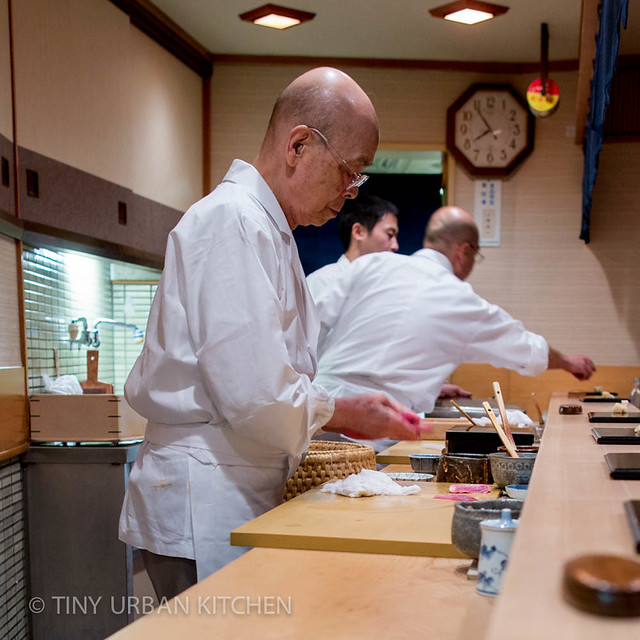
Of course, we still had sushi. In fact, we had a chance to taste sushi made by probably the most famous sushi master in the world right now.

Here's a brief summary of where we went on our trip, all to be described in mouthwatering detail in the upcoming posts in this new series: Tasting Tour of Tokyo.
Joel Robuchon Tokyo
This pic is just for fun. It's the gorgeous mansion that houses Joel Robuchon in Tokyo. It was right across the street from our hotel, so I walked by it everyday. Alas, my biggest regret is that I never took the opportunity to pick up some fresh baked items from the bakery downstairs.
Homemade Soba with quail egg and mountain yam
Bryan loves fresh noodles, so we visited this quaint, cozy, and very, very Japanese (the entire menu was not even translated) soba shop that made its own soba, served here with mountain yam (yamaimo) and quail egg.
Tsukemen from Rokurinsha
Speaking of noodles, I queued up for over an hour for one of the best bowls of ramen I've ever had at this simple, tsukemen (dipping noodles) shop inside the Tokyo Sky Tree complex.
Fried Bitter Melon Snacks
I love snacks, and it's always fun to see what different countries eat. I stopped by a 7-11 and picked up these cool, fried, bitter melon chips (surprisingly tasty!).
Asakusa Street Food
Of course, the most fun place to get Japanese snacks is to stroll the street at Asakusa leading up to the Sensō-ji Temple, where vendors sell snack-sized, freshly made portions of all sorts of goodies, such as homemade sembei (rice crackers), mochi balls, ningyoyaki (red bean filled cakes), and many other fun, delectable nibbles.

This street is walking distance to Kappabashi, my favorite place to shop for inexpensive, Japanese kitchenware. It was easy and pleasant to visit both during one of my day-excursions while Bryan was at work.
Akihabara
While I always want to visit Kappabashi, Bryan invariably wants to go to Akihabara, electronics capital of the world. This time, we browsed endless rows of iPhone 5 cases (every type imaginable), as well as tons of other types of fun gadgets. Seriously, there's nothing else like this place in the world.
Tokyo Station Character Street
I finally found "Tokyo Character Street", a fun section in the Tokyo Train Station that houses stores devoted to different Japanese characters. Immerse yourself in all sorts of fun products featuring the likes of Domo-kun, Hello Kitty, Doraemon, Snoopy, and Totoro (just to name a few!).

I didn't find out until later that Ramen Street was just around the corner - gahhhh! Next time, next time . . .
Odaiba
To relax, I took the monorail train across the beautiful Rainbow Bridge to Odaiba, a manmade island right in Tokyo Bay that offers gorgeous views of Tokyo, funky futuristic architecture (reminds me of Tomorrowland in Disneyland), as well as many recreational activities.
Matsutake Soup from Kikunoi
On my first night dining alone, I visited a two-star Michelin kaiseki place whose "mother ship" restaurant in Kyoto actually has three Michelin Stars. Matsutake mushrooms were in season at the time, and I had a sublime soup made out of them.
Wagyu Beef from Ukai-tei
Bryan has always wanted to try really, really good Japanese beef, so we tried ukai-gyu, top quality black beef (a breed of Wagyu) at a one-star Michelin Japanese teppanyaki place. Bryan's thoughts? "Best steak I've ever had in my life."
Tempura Mikawa Zezankyo
Tempura is treated very, very seriously here in Japan, to the point that it's an art form. I trekked out into the "burbs" in order to enjoy ethereal seasonal tempura (uni & shiso on left and gingko nuts on the right) made by a famous tempura-maker who essentially came out of retirement to open his own shop.
Kyushu and Hokkaido Uni from Sushi Aoki
Although we tried more of a variety of food, we had to at least eat some sushi in Tokyo. After all, sushi is really one of Tokyo's specialties. We sampled different types of uni (sea urchin) from two different regions at this one-Michelin star sushi place in Ginza.
Sushi Sawada
We weren't allowed to take pictures at this tiny, seven-seater two-star Michelin sushi restaurant, where the entire meal is prepared solely by the sushi master and his wife.
Sukiyabashi Jiro
And finally, the epitome of our trip - a chance to try sushi made by the eighty-six year old master (first ever to get three Michelin stars for sushi) in a tiny, basement shop right inside the Ginza subway station.

It was a fabulous yet whirlwind trip (we were there for only 5 and a half days!), and I can't wait to share the details of it with you. Stay tuned!

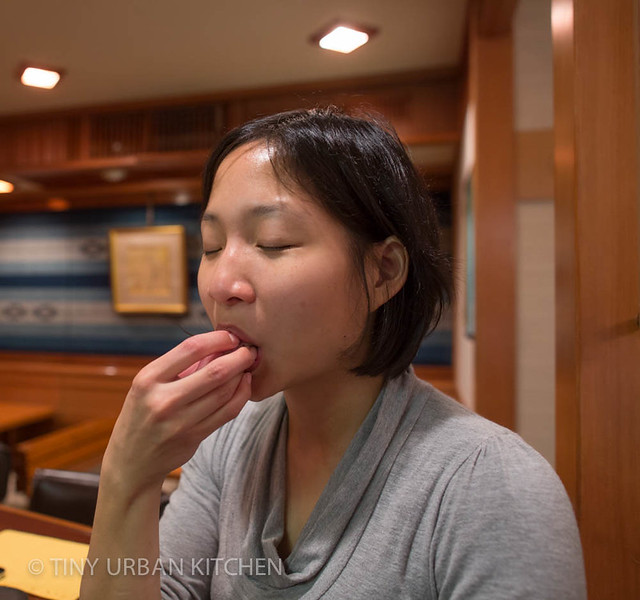
Jen at Sushi Jiro
P.S. Yes, you're supposed to eat nigiri with your hands.