Showing posts with label Pork. Show all posts

Thursday, January 10, 2013

Chashu Pork Roast (pressure cooker)

Untitled
This post is a part of a larger post about making ramen using a kit from the famous ramen shop in Tokyo, Rokurinsha.

I hope this doesn't get old too soon, but I'm having so much fun with my new pressure cooker.

I'm still floored by the idea that something that should take hours to cook can be finished in 1/3 the time, just because it's cooked under a higher pressure (and thus a higher temperature).
Untitled
I decided to make braised chasu pork as one of several components of my super complicated "instant" ramen from Rokurinsha in Tokyo. I was already cooking the pork belly sous vide for 36 hours; why not go all out and try to cook the pork roast in a pressure cooker?

I had actually originally planned on making pork shoulder. Unfortunately, the normal American supermarket that I visited didn't have any, so I had to settle for "pork roast", which is leaner than shoulder (or butt), and therefore, harder to make super soft and tender.

Nevertheless, the pressure cooker performed gorgeously.  I stopped by a grocery store on my way home from work; picked up some pork roast; and managed to cook the meat in an hour for our ramen dinner.

Untitled
The recipe is pretty simple, actually. Gather up your typical Asian aromatic (onions, ginger, garlic, and scallions).
Untitled
Briefly brown the pork roast until a nice, brown surface forms on both sides.
Untitled
Add your aromatics.
Untitled
Then add all the lovely flavoring liquids, such as soy sauce, mirin, sake, and water. Cook under pressure for about 1 hour (minimum), and 2 hours for insanely soft results.

We did eat a portion of it after it had cooked for one hour. We left the rest of it in the pressure cooker and continued to cook it for another hour. After two hours, even the super lean pork roast was meltingly tender.

I'm guessing if you used pork shoulder/butt (which is higher in fat content), you won't need to cook it for as long as I cooked the pork roast.

Assemble, and enjoy!
Untitled

Chashu Pork Roast
2 lbs pork shoulder
200 mL soy sauce
200 mL sake
200 mL water
100 mL mirin
5 tablespoons sugar
2 stalked of scallions
5 cloves of garlic
2 inch knob of ginger

Sear pork shoulder on all sides in pressure pot. Add liquids and aromatics. Cook until sugar is melted. Cover and wait until pressure reaches 4 bars. Cook for 2 hours. Cool and slice.

36-hour Sous Vide Chashu Pork Belly

UntitledThis post is a part of a larger post about making ramen using a kit from the famous ramen shop in Tokyo, Rokurinsha.

Pork belly is a tricky thing to cook.Because it has quite a bit of fat and collagen, it needs to be cooked for long periods of time before it becomes tender. Unfortunately, the higher the temperature at which you cook your meat, the more moisture it loses, and thus the tougher it becomes. Therefore, making good pork belly involves dancing in between that fine line of finding the optimal temperature and time.

UntitledThe Modernist Cuisine at Home outlines various temperatures and times for cooking pork belly using sous vide. The general rule is - the lower the temperature the longer the cooking time. I decided to go with 36 hours, since The Modernist said there was not much noticeable difference in tenderness between 36 hours and longer cook times.

According to some sources, it's preferable to roll up the pork belly to prevent moisture loss. My pork belly came rolled up already, so I didn't need to add that extra step. For presentation purposes, it's nice to have it rolled up so you can slice it that way later. UntitledMake your marinade by heating up soy sauce, mirin,and sake with sugar until the sugar is completely melted.UntitledOnce slightly cooled, pour this marinade into a vacuum bag with the pork belly and seal. Hanging the bag over the edge was the best way I found to vacuum seal a bag full of liquid (something the FoodSaver does not usually handle).UntitledCook for 36 hours with liquid at 146° F. I actually ended up cooking it for closer to 40 hours since I didn't come home from work until the evening.Untitled
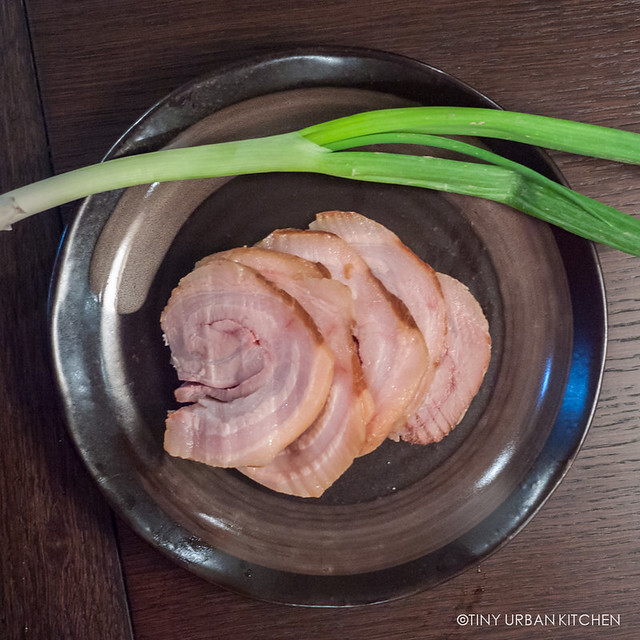
At this point, the pork belly is gorgeously soft and gelatinous. Wait until it cools. Once cool, you can easily slice it with a knife into thin slices for ramen.Serve with your favorite ramen dish!Enjoy!UntitledSous Vide Chashu Pork Belly

Adapted from this recipe

2 pound slab of boneless pork belly, rolled up

Marinade
1/2 cup soy sauce
1 cup sake
1 cup mirin
1/2 cup sugar
6 scallions, roughly chopped
6 whole garlic cloves
one 2-inch knob ginger, roughly sliced

1. Heat up soy sauce, mirin,and sake with the sugar in a small saucepan until the sugar is melted.
2. Add scallions, garlic cloves, and ginger. Let cool.
3, Pour the marinade into a vacuum sealer bag with the pork belly and vacuum seal the entire thing.
4. Sous vide cook for 36-40 hours with liquid at 146° F.
5. Remove the bag from the sous vide machine.
6. Cool down the meat by either putting the entire bag into an ice bath (if you need it soon), or let it cool in the refrigerator overnight. Don't try to slice it when it's hot - you will fail.
7. Once cool, remove from bag, dry off the liquid, and slice.
8. Serve in your favorite ramen dish!
Untitled

Tuesday, December 27, 2011

Butagumi

Tonkatsu
This is part 5 of my latest travel series: Post Quake Japan. Other posts in this series: KagoDaisan HarumiTempura Kondo, and Sushi Mitani.

In a residential part of Tokyo, far from the hustle and bustle of typical Tokyo life, lies a little whimsical house with a crescent moon cut into the side of it.

The journey here is idyllic – step off the beaten path, meander through some lovely parks, and emerge in a little neighborhood to discover Butagumi, a restaurant that arguably serves the best tonkatsu in all of Tokyo.
Butagumi
What makes Butagumi unique?
There are many, many well-known tonkatsu restaurants in Tokyo. The most famous one is probably Maisen, a tonkatsu restaurant housed inside of a former WWII bathhouse.

Unlike Maisen, which sells all sorts of fried items (pork, prawns, potatoes), Butagumi specializes in pork only. The moment you enter the restaurant, you are greeted with a refrigerated display case showcasing many gorgeous cuts of pork.
pork at Butabumi
Butagumi is particularly unique because it has an incredibly diverse range of pork selections. Unlike most tonkatsu places, which may offer one or two choices of pork, Butagumi offers over 50 different varieties of pork – everything from the Kagoshima region’s kurobuta (Berkshire pork) to Spain’s highly prized Iberico pork. The selection varies every day, but on any given day you still have several dozens from which to choose.

Even wall decorations remind you the focus of this special place.

The menu lists which varieties of pork are available that particular day.  If you really can't decide (and many people cannot), a popular option is to try the "Butagumi-zen" (3000 yen), a tasting plate which allows you to try small portions of 5 different kinds of pork.
5-piece tonkatsu tasting
The Butagumi-zen always includes the Iberico pork, which is definitely one of the tastiest (and most expensive) cuts on the menu. If you do order this tasting set, definitely eat the Iberico one last; otherwise, you will be disappointed with anything afterward!

Although the tasting is fun to get, I still think you should order a whole tonkatsu to get the real experience. The tasting pieces are small and are breaded all the way around. The entire piece becomes less “meaty” and, in my opinion, does not taste as good as a traditional slice of a tonkatsu filet.
Spanish Iberian Pork Tonkatsu
If you want to go all out, you can do what Bryan did, which is to get a single order of the Iberico pork tonkatsu (4800 yen). Each order actually comes tagged with a number, likely indicating how many they've sold in the lifetime of the restaurant. Typically, you can choose either a rosu ("roast") or a hire ("fillet") cut. The rosu is pork loin near the lower part of the ribs and is typically juicier and fattier. The hire is tenderloin, and is leaner, but also not as juicy! Usually the staff will recommend rosu since it is juicier and tastier.

If you're not quite ready to shell out close to $70 for a piece of tonkatsu, you can always get the normal tonkatsu lunch special, which is still good and much more easy on the wallet at 1500 yen. Other possible interesting pork types include Tokyo X, SGP (Super Golden Pork), the Mangalitsa pork from Hungary. For an excellent, in-depth description of many of their pork offerings, check out this post.
pickles
 Like at all tonkatsu restaurants, Butagumi serves tonkatsu with pickles and shredded cabbage.
shredded cabbage

But the pork - how did it taste?
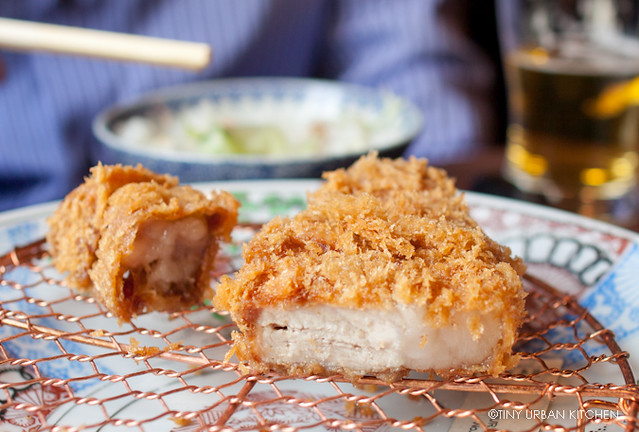
Oh, of course, how could I forget! The pork was absolutely phenomenal, definitely among the best tonkatsu we have ever had. The Iberico pork tonkatsu was especially delicious – fatty, juicy, and full of flavor.
tonkatsu
The crunchy, breaded exterior was perfect – not too greasy yet satisfyingly crispy. If you are a pork aficionado, or if you just really like trying different varieties of pork, Butagumi is an excellent place to visit. The ambiance is comfortable yet quaint; the food is incredible; and the menu offerings are really unique and hard to find anywhere else.

Butagumi is a little off the beaten track. It sits inside a super cute house that was converted into a restaurant years ago. Enter and walk up the wooden, slightly creaky stairs to the second floor, where, if you’re lucky, you can actually sit next to the crescent window!
Butagumi

Butagumi
2-24-9 Nishi-Azabu
Minato-ku, Tokyo
(港区西麻布2-24-9)
Nearest station: Roppongi

Wednesday, November 30, 2011

Roasted Bacon Wrapped Pork Loin

Roasted Bacon Wrapped Pork Loin
This is part 3 of the Post Project Food Blog - What's Next? Series. Other posts in this series: Why Boston Rescue Mission, Boston Rescue Mission: Sunday Community Dinner

This bacon wrapped oven roasted pork loin is the home version of a dish that I make (with lots of help, of course!) for > 100 people at the Boston Rescue Mission during their Sunday Community Dinner.

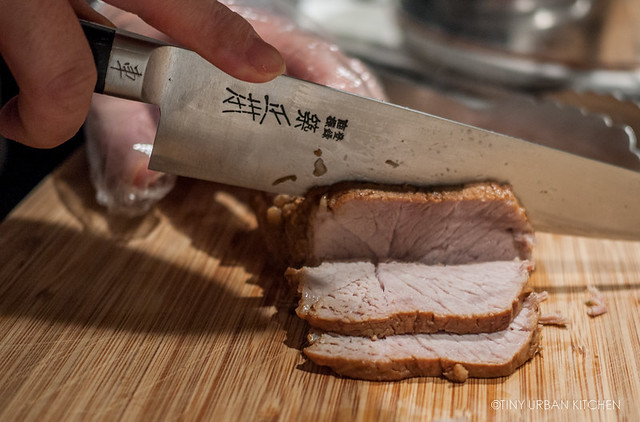
The nice thing about making just a single serving at home (as opposed to making 10 times the amount in commercial ovens), is that I can actually cook the pork a lot less (compared to at the shelter, where we essentially have to cook everything well done). Here, I decided to cook it to a perfect medium, just slightly pink in the middle.

It was juicy, tender, and absolutely fantastic.

Why, if given the choice, would anyone cook pork any more than this?
Roasted Bacon Wrapped Pork Loin
First, rub minced garlic, salt, and pepper all over the pork loin.Roasted Bacon Wrapped Pork Loin
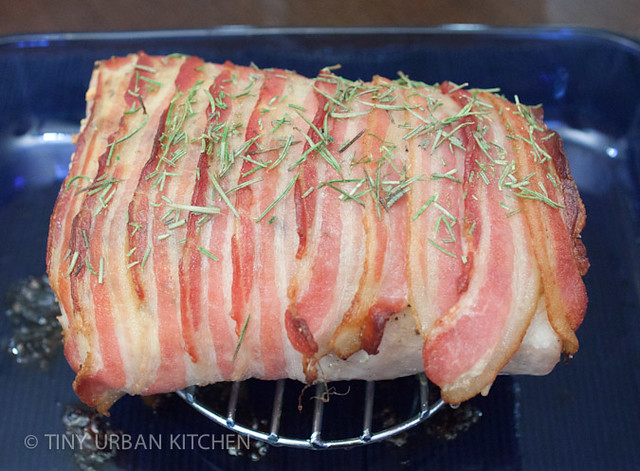
Wrap bacon around the loin so that every inch is covered. You may want to experiment and use different kinds of bacon if you wish (e.g., maple bacon, or black forest?). Roasted Bacon Wrapped Pork Loin
Sprinkle with crushed fresh (if possible) rosemary leaves.Roasted Bacon Wrapped Pork Loin
Bake in the oven at high heat (450 °F) for 15 minutes to crisp up the bacon. Then reduce heat to 375 °F and cook for another hour or so (until internal temperature reaches something with which you are comfortable. I was pretty risky and I think I took it out even before it reached 150°F internal temperature).
Roasted Bacon Wrapped Pork Loin
Let rest for about 10-15 minutes.
Roasted Bacon Wrapped Pork Loin
Slice and enjoy! Bryan loves slightly undercooked meat, so he was thrilled with the results. This pork loin is juicy, tender, yet flavorful especially due to the bacon, garlic, and rosemary.


Bacon Wrapped Pork Loin
Adapted from The Hungry Mouse
Serves 6-8

1 pork loin, about 4 lbs.
7 cloves garlic, mashed
7-8 slices bacon
kosher salt
optional freshly cracked black pepper
2 tsp. rosemary

1. Rub the pork loin all over with minced garlic, salt, and pepper.

2. Wrap bacon slices around the pork loin until completely covered.

3. Sprinkle the loin with crushed fresh (if possible) rosemary leaves.

4. Bake in the oven at high heat (450 °F) for 15 minutes to crisp up the bacon. Then reduce heat to 375 °F and cook for another hour or so (until internal temperature reaches 150°C.

5. Tent with foil and let rest for about 10-15 minutes.

6. Slice and enjoy!

Monday, April 4, 2011

Maisen


This post is part 6 of my series: Tribute to Japan. Other posts in this series include: Part 1: Kappabashi-dori, Part 2: Tapas Molecular Bar, and Part 3: Suzuran (Ramen)
Part 4: Japanese Matcha and Azuki Breads, Part 5: Masamoto Tsukiji Knives

Here in America, it's tough to truly appreciate the nuances and diversity of Japanese cuisine.

In most parts of the US, all Japanese food is lumped together in one restaurant. Sure, some of you are lucky enough to live in New York, San Francisco, or Los Angeles, where you'll actually see dedicated ramen shops, sushi restaurants, or izakayas.

For the rest of us, however, "Japanese food" connotes this general idea which is essentially a mish-mash of popular Japanese dishes - spicy tuna rolls, shrimp tempura, noodle soups, a curry dish, and inevitably your chicken or salmon teriyaki bento box. If you're lucky, you might see tonkatsu or its cousin, katsu-don on the menu.

One thing I love about visiting Japan is the opportunity to learn about (and taste!!) all different types of Japanese food at dedicated, specialty shops. For example, visit the best shabu shabu restaurant in Tokyo, and you'll receive a menu that's literally just full of different shabu items (e.g., Kobe beef . . . sooo good!). Similarly, there are scores of ramen shops, curry houses, and all sorts other shops dedicated to various narrow slices of Japanese cuisine.

One of my favorites? Tonkatsu.

Surprised?  Indeed, there are many dedicated tonkatsu restaurants in Japan.

Tonkatsu is a breaded and deep fried pork cutlet, usually served with a thick, tangy sauce ("Tonkatsu sauce"), shredded cabbage, and miso soup. Inspired by European cuisine, it first appeared in the late 1800's in a Western-food restaurant in Ginza, Tokyo.

Maisen take-out counter

These days, Maisen in Tokyo is pretty universally acknowledged as one of the best tonkatsu houses in the city.  Their signature dish is the kurobuta tonkatsu (literally "black pork," also known as Berkshire pork in the US). Kurobuta is known for its high fat content and intense, juicy flavor.

The restaurant is uniquely situated inside a former World War II public bathhouse. In fact, the main dining room (pictured above) was once the changing room, complete with some of the original architectural details in the high ceilings.


There's a simple English menu, but we could clearly tell that it only had select items on it. The Japanese language menu is an entire book which, thankfully, has a tons of pictures. Bryan and I both decided to go for the kurobuta set menu, which came at quite the hefty cost (around $35 each! - Grr . . horrible exchange rate!)
Tonkatsu Maisen
I still remember asking the server in my broken Japanese, "what's the difference between hire (fillet) and rosu (loin)?"

She smiled, "rosu has more fat."

"Which one is better?"

She smiled, "Definitely rosu."

We immediately got two orders of kurobuta rosu.

Wow.

There's no question - this is seriously by far the BEST tonkatsu I've ever had anywhere in the world. There's really no comparison. The meat is flavorful, tender, and deliciously juicy. The outer panko breaded layer has a nice crunch to it without harboring any hint of greasiness. We first visited this place in 2009 and we made sure to return this time again.

As part of the set menu, you get a nice, light miso soup (complete with konnyaku!), along with some pickles, shredded cabbage, and rice.

Finish off with a perfect palate cleanser of citrus sorbet and fruit.


General Notes
The restaurant is pretty hard to find. It's hidden behind the Omotesando Hills shopping complex not too far from Harajuku. Thankfully, there are several signs that point you through the meandering backroads which eventually lead to the restaurant. I'd recommend bringing a map or taking a taxi! [In either event, definitely spend some time exploring both Omotesando and nearby Harajuku by foot!}

We were staying in Shibuya, so we actually walked here.

Just follow the yellow, circular signs!

Definitely check out this place if you like tonkatsu. Not only is the food unbelievably delicious, you get to experience a bit of history by dining inside of a WWII public bathhouse. It's conveniently close to Harajuku, Omotesando, and Shibuya, which are must-visit destinations in Tokyo anyway, so why not stop by for a meal while you're there?

Maisen
4-8-5 Jingumae
Shibuya-ku
Tokyo
Phone: 03/3470-0071

Related Posts