Showing posts with label Asia. Show all posts

Tuesday, May 14, 2013

Tab Tim Grob (Rubies in Coconut Milk)

_DSC1419
This is the final of four dishes that I learned to make during my 4-hour cooking class at BaiPai Cooking School in Bangkok, Thailand. This is a mini-series that's part of a larger Thailand! travel series of my eats in Bangkok. Scroll to the bottom of the post to see all the posts in this series.

These changes in the weather lately are driving me crazy.

The teasing few days of warm weather we had last week (high of 80° F!!) flipped a switch within me. All of a sudden, I was decidedly done with winter. Over the weekend, I grabbed all my down jackets and wool coats and put then into storage. Same with the boots and winter gear.

Yesterday morning I walked out in a thin jacket and a short sleeved shirt, only to turn right around after walking outside in order to grab a warmer jacket.

But warm days are coming very soon. And before we know it, we'll be longing for relief from the hot weather.

On that note, we end our Thai cooking school series with one of my favorites. It's a dessert that's perfect for times when it's really hot outside. Served over ice, Tab Tim Grob is extremely refreshing and cool. The bright colors also make me think of summer.
_DSC1416-2  "Tab tim" means rubies or pomegranate and "grob" means crunchy.

These gorgeously colorful "jewels" do indeed resemble pomegranate seeds in some way. Water chestnuts are covered in an ever-so-thin dusting of tapioca flour and then boiled briefly. What results is a perfect "seed" with a slightly crunchy center and a soft, clear outer layer.

I had never heard of this dessert before coming to Thailand. By the time I left Thailand, I was convinced it was one of my new favorite desserts from the country.
_X1C4457

How to Make Rubies
Cut up water chestnuts into small cubes. If you are using the canned variety, soak them in water for 10 minutes first before soaking. Soak the water chestnut pieces in red grenadine or red cordial. You can also use dark red juices or red food coloring. [Please note that this step is merely for show. The color will not affect the flavor, and therefore if you don't want to use coloring, you can skip this step. [You can also use other colored cordials or food coloring, but then maybe you'll have to change the name to "emerald" or "sapphires" in coconut milk!].

While waiting for the water chestnuts to turn red, make your syrup and coconut mixture. Both are pretty easy to make. For the syrup, just bring sugar, water, and pandanus leaves to a boil over low heat. Let simmer for 15 minutes (no need to stir).

Note: this syrup can last for up to one month in the refrigerator if you want to make a larger batch.
_X1C4413
To make the coconut milk mixture, boil coconut milk and water together in a pot over medium heat. Keep stirring to prevent the oil from separately out of the coconut milk. You can optionally add pandanus leaves to the coconut milk as well if you want that flavor. Set aside once everything is melted and well mixed/incorporated.
WaterChestnutRubies.jpg
After the water chestnuts have been soaking for one hour, they should nicely bright and red. You are ready to cook the "rubies"! Toss the soaked water chestnuts in tapioca flour until they are completely covered. Remove the powdered water chestnuts from the tapioca flour, shaking to remove excess flour.
_DSC1380.jpg
Bring a pot of about 2 cups of water to a boil. Add the water chestnuts and count to 10. Stir once and wait until the water returns to a boil and the water chestnuts float to the top (about 20 seconds). Using a slotted spoon, remove the water chestnuts and dunk them into an ice bath.
_X1C4458.jpg
Once you're ready to serve, drain the water chestnuts well with a slotted spoon, and place them in the bottom of a dessert bowl. Add syrup, coconut mixture, and crushed ice.

Tasting Time!
I fell head over heels in love with this dessert. The water chestnuts have this really unique texture where they are soft and chewy on the outside yet slightly crunchy on the inside. The sweet-salty combo from the slightly salty coconut milk base and the sweet pandan-infused syrup is seriously addictive. Even though I was beyond stuffed from an afternoon of eating Golden Bags, Larb Gai, and Pad Thai, and I still polished off my entire bowl of this refreshingly delicious dessert.

Throughout the rest of my short trip in Thailand, I desperately sought this out at restaurants.

I can't wait to make it at home again!
_DSC1417.jpg


Tim Tab Grob (Rubies in Coconut Milk)

Water Chestnuts
30g peeled water chestnuts, boiled and diced
2 T red grenadine or cordial (or food coloring)
2 T tapioca flour

Syrup
1/2 cup sugar
1/4 cup water
1-2 Pandanus leaves
(or 1-2 drops Pandan extract)

Coconut Milk
1/2 cup coconut milk
1/2 tsp salt

Soak water chestnuts in grenadine for 1 hour.  If you are using canned water chestnuts, soak them in water for 10 minutes first before putting them in the red coloring liquid.

Meanwhile, heat the sugar, water, and pandanus leaves (torn to release flavor) into a saucepan. Bring to a boil over low heat and then let it simmer for 15 minutes.

In a separate saucepan, heat coconut milk and salt (and optionally torn pandanus leaves) to a boil. Continue stirring to prevent the coconut oil from separating out. Set aside.

After 1 hour, transfer red water chestnuts into tapioca flour and toss with flour until well covered. Bring 2 cups of water to a boil and add the water chestnuts, cooking for 10 seconds. Stir and wait until the water boils again and the water chestnuts float to the top. Transfer to a bowl of ice water to stop the cooking process.

To serve, combine water chestnuts, syrup, and coconut mixture in a bowl and add crush ice. The amounts are flexible. Taste it and add more or less depending on how sweet you want it to be.

Enjoy!

This is the sixteenth post in the Thailand! travel series of my eats in Bangkok. Other posts include:

Eats!
Thip Samai, Best Pad Thai in Bangkok?
Raan Jay Fai, Best Drunken Noodle in Bangkok
Street Foods of Bangkok, Part I
Street Foods of Bangkok, Part II
Fun Fruits in Thailand 

Cool Experiences
Maeklong Railway Market
Floating Markets (Damnoen Saduak)

Cooking Classes + Recipes
Somphong Thai Cooking School 
Som Tam (Papaya Salad)
Thai Panaeng Curry Chicken
Bananas In Golden Syrup
BaiPai Thai Cooking School
Golden Bags
Larb Gai (Laap Gai)
Pad Thai

Thursday, May 9, 2013

Golden Bags

_DSC1398.jpg
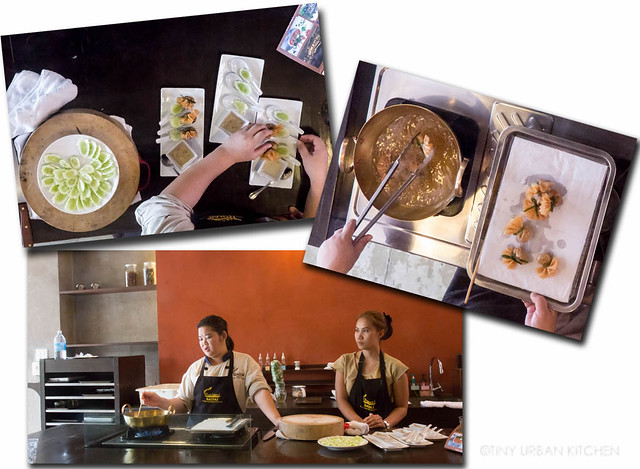
This is the first of four dishes that I learned to make during my 4-hour cooking class at BaiPai Cooking School in Bangkok, Thailand. This is the thirteenth post in the Thailand! travel series of my eats in Bangkok. Scroll to the bottom of the post to see other posts in this series.

In my way-too-short five days in Bangkok, I packed in two cooking classes over two days where I learned how to make seven different Thai dishes.
GoldenBagsAbove.jpg
Having very little exposure to Thai food before I traveled there, every new dish was a new adventure. I loved learning about the street food, fresh market produce, and dishes from various regions around Thailand. The cooking classes were great because they got me familiar with Thai ingredients and how to cook them.

Unfortunately, it's harder to get some of these ingredients halfway around the world. There are certainly some dishes that just won't be the same if I try to remake them here in the US.
_DSC1393.jpg
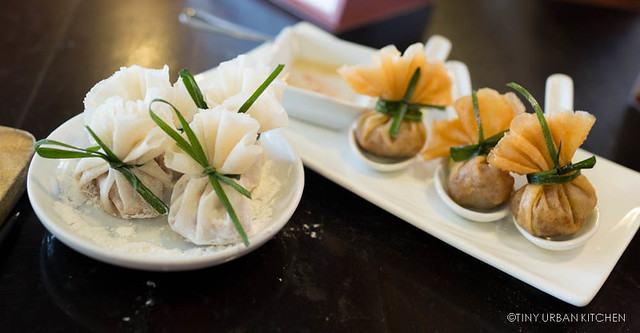
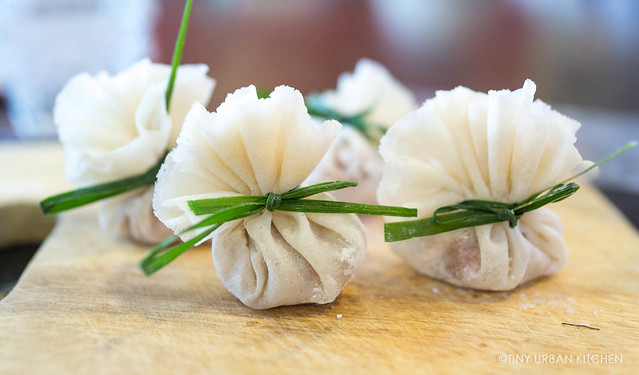
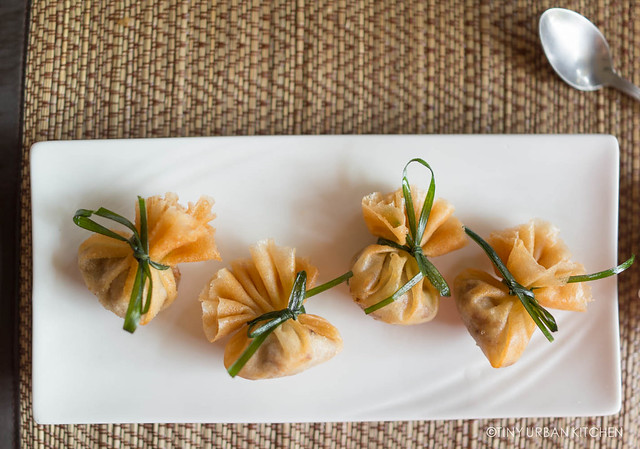
However, other dishes will translate quite well across the ocean, and I think these deliciously cute little Golden Money Bags are definitely one of them. This particular appetizer relies a lot less on the distinct flavors of Thailand-specific ingredients. It's actually quite flexible, and therefore I think it can stand up to a lot of substitutions.

Better yet, they impressive to look at yet surprisingly really easy to make. I was floored how perfectly my little bags turned out, even though it was my first time ever making them!
GoldenBagsFilling.jpg
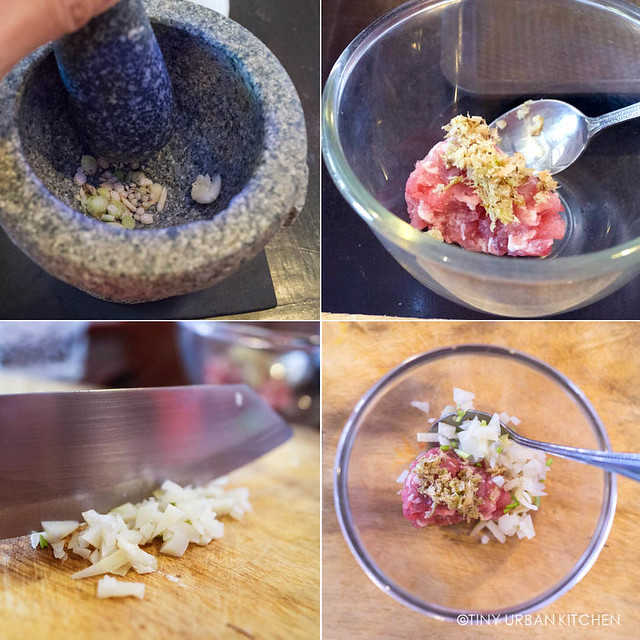
Grind the white peppercorns, garlic, and cilantro root together to form a paste. We used the traditional Thai mortar & pestle, but you could just as easily use a mini food processor. If you don't have cilantro root, you can substitute with the leaves and stems. Add this to the ground pork, cilantro, chopped water chestnuts, onions, sugar, and soy sauce. Mix it up!
GoldenBags.jpg
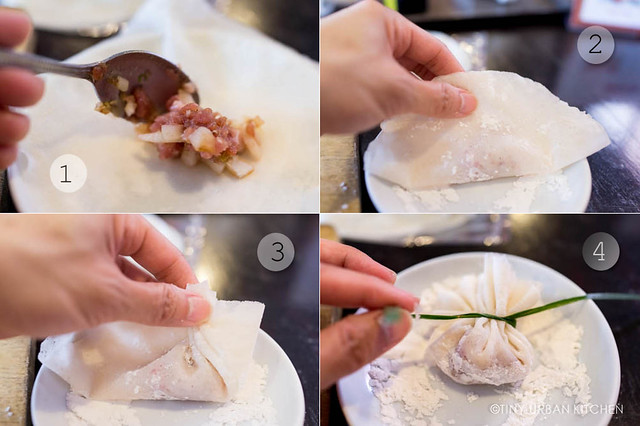
In Thailand you can easily buy fresh wrappers in the market. In the US, you will likely have to go to an Asian market (probably the frozen section) in order to get these spring roll wrappers. Let the wrappers defrost in the refrigerator, and then just make sure to keep them moist (e.g., store the wrappers under a wet paper towel while wrapping so they don't try out).

Wrap according to the steps shown above.
_DSC1390.jpg
Tie up the golden bags using your green strips of Pandanus leaves. Use Chinese chives or scallions as a substitute. It is good to parboil your leaves before using them in this recipe. It makes them more flexible and prevents them from breaking when you try to tie them into a bow.
_X1C4472.jpg
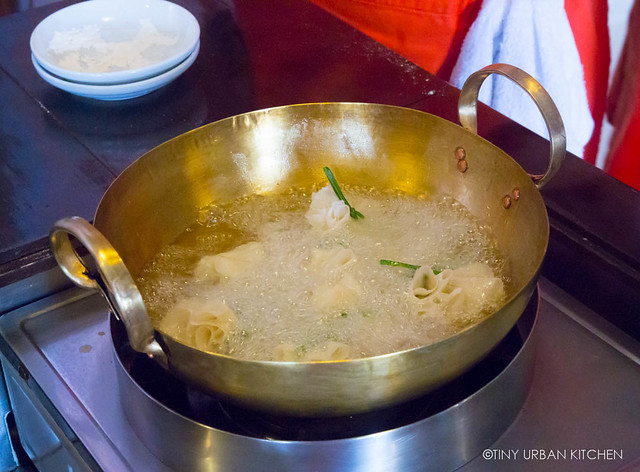
Heat up about 2 cups of oil to ~180 °C (~356 °F). One way to check whether the oil is hot enough for frying is the "chopstick test." Stick a wooden chopstick into the oil. If tiny bubbles form around the oil, it means the oil is ready.
_DSC1395.jpg
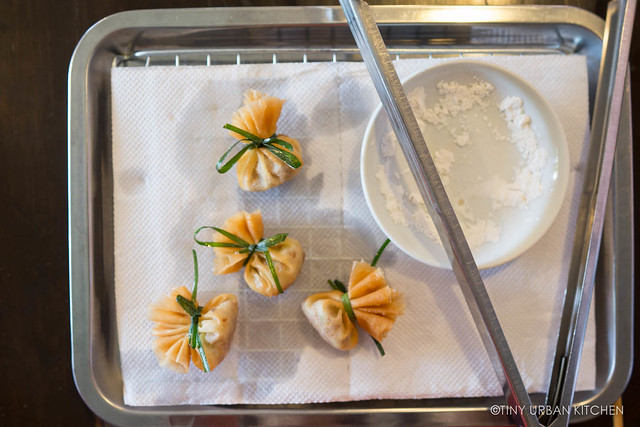
Fry until golden brown (3-5 minutes?) and then remove to let cool. Ideally, place them on paper towels to cool a bit so some of the oil can drain off.
_DSC1392.jpg
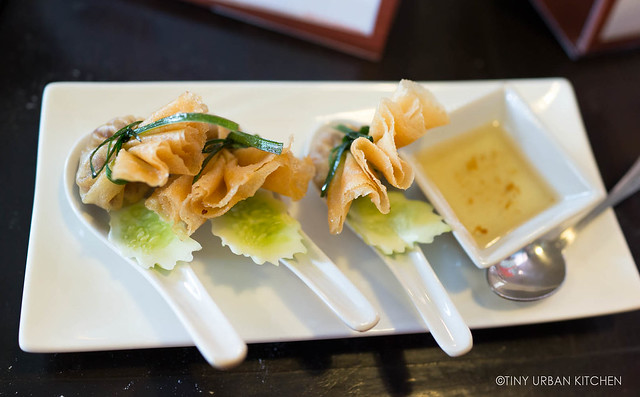
Because the bags are deep fried, it's nice to balance them out with something light and crisp, such as sliced raw cucumbers.

Serve with a sweet and sour plum sauce. Unfortunately, I don't have a recipe for the plum sauce. They just served it to us at the school.

Enjoy!

Golden Bags
makes 4 bags

Filling
20g minced pork
5 white peppercorns
1 clove of garlic, finely chopped
1/4 tsp finely chopped cilantro root
1-2 stalks cilantro, chopped
5g water chestnuts, chopped
5g onions, chopped
2 cups oil (for deep frying)
1/4 tsp sugar
1/2 tsp soy sauce

Bags
4 spring rolls wrappers
1 Pandanus leaf, pulled into strips and parboiled
(note, if not available, can use scallions or Chinese chives, which don't need to be pulled into strips)

Grind the white peppercorns, garlic, and cilantro root together to form a paste (mortar & pestle or food processor). Combine with ground pork, cilantro, water chestnut, onions, sugar, and soy sauce. Mix well.

Wrap a spring roll wrapper around about 1 tsp filling and tie together with the Pandanus leaf.

Deep fry at 180 °C until golden brown.

Serve!

This is the thirteenth post in the Thailand! travel series of my eats in Bangkok. Other posts include Thip Samai, Best Pad Thai in Bangkok? and Raan Jay Fai, Best Drunken Noodle in Bangkok, Maeklong Railway Market, Floating Markets (Damnoen Saduak), Street Foods of Bangkok, Part I, and Street Foods of Bangkok, Part II, and Fun Fruits in Thailand plus posts about recipes from my cooking class at Somphong Thai Cooking School including Som Tam (Papaya Salad), Thai Panaeng Curry Chicken, Bananas In Golden Syrup, and BaiPai Thai Cooking School.

Monday, April 29, 2013

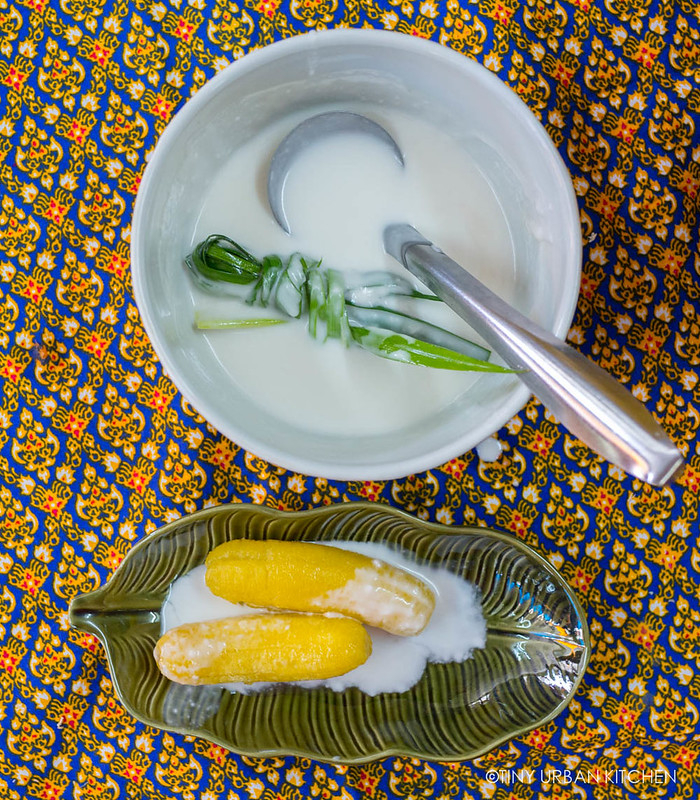
Bananas In Golden Syrup

_DSC1355.jpg
This is the eleventh post in the Thailand! travel series of my eats in Bangkok. Other posts include Thip Samai, Best Pad Thai in Bangkok? and Raan Jay Fai, Best Drunken Noodle in Bangkok, Maeklong Railway Market, Floating Markets (Damnoen Saduak), Street Foods of Bangkok, Part I, and Street Foods of Bangkok, Part II, and Fun Fruits in Thailand plus posts about recipes from my cooking class at Somphong Thai Cooking School including Som Tam (Papaya Salad), Thai Panaeng Curry Chicken, and this post.

I did not expect to like this dish at all.

In fact, when I first saw that there was a banana dessert on the menu for the cooking class, I sort of cringed. After all, I've never liked bananas. There's something about the flavor that just sort of rubs me the wrong way. I can't place my finger on it, but it's definitely something I don't eat often.

But because the Thai cooking class I was taking at the Somphong Thai Cooking School included other pretty amazing dishes, such as Green Papaya Salad and Panaeng curry, I decided to stick with this particular class.

And I stand corrected.

Bananas can taste good. Really, really good.

This dessert is our cooking instructor's favorite dessert, and I can totally see why. It's super easy to make, and the sweet-salty combination of the sweet bananas with the savory coconut cream sauce works together surprisingly well.

I hate to say this, but it was almost mildly addictive.
_X1C4349.jpg
The bananas used in this dessert are not the normal large bananas we see in North America. Instead, these are mini bananas that are about half the length of the big bananas we are used to seeing in the States.
_X1C4537
Here's a woman selling these little bananas on skewers at the floating markets at Damnoen Saduak.
_DSC1336.jpg
You want to use bananas that are still pretty green (see color in the photo). They need to be firm so they can stand up to the cooking. Remove the peels from all the bananas. You can peel them traditionally by hand, or use a knife to speed up the process.

To prevent bananas from turning brown after peeling, place them immediately in a bowl of water acidified wi lime juice.
_X1C4410.jpg
We will cook these bananas in a fragrant, pandan-infused syrup. Pandan is a tropical plant commonly used in Southeast Asia in both sweet and savory applications. It has a sweet, fragrant aroma that is very pleasing, making it a popular flavor used in many desserts. If you don't have pandan, you can either add a few drops of pandan essence (a little goes a long way!) or even vanilla extract would work fine too.

Combine sugar, salt, pandan leaves, and water in a pot and bring to a boil.
_X1C4415.jpg
Add bananas, reduce heat, and cook until the bananas turn a darker shade of yellow, maybe 10-15 minutes. Try not to disturb the bananas too much, though you can flip them once in the middle if desired.
_X1C4413
Meanwhile, make your savory coconut cream. It's pretty easy - just dissolve coconut cream with salt and a bit of rice flour to thicken it up. If you want, you can add some pandan leaves for extra flavor, but this is optional.

Once the bananas are done, remove them from the pot, straining out the syrup. Optionally squeeze lime on top, and pour the savory coconut cream sauce all over the bananas.

Serve!
_X1C4416
Clearly the students couldn't get enough of this dish, including a very surprised me, who shocked herself by going back for seconds.

Love that sweet + salty combo. Seriously addictive.

Enjoy!

Bananas in Golden Syrup

Bananas
8 small golden bananas
2 cups water
1 cup sugar
1/4 tsp salt
1 tsp lime juice
Pandan leaves (optional)
Vanilla flavoring (optional)

Peel bananas and immediately put them in a bowl of water to prevent further browning. In a pot, bring sugar, water, salt, and pandan leaves to a boil. Reduce heat and add bananas, cooking at low heat until the bananas turn a darker shade of yellow. Add lime juice and then remove bananas. Top with coconut cream topping (see below for recipe).

Serve!

Coconut Cream Topping
1 cup coconut cream
1/4 tsp salt
1 tsp rice flour*

Add the rice flour to the coconut cream (room temperature). Heat over medium heat until the mixture becomes thick and sauce-like. Add salt and stir to dissolve. Set aside.

*I believe the purpose of the flour is mostly for texture, so if you can't find rice flour, other substitutes may work, such as all purpose flour.

Thai Panaeng (Penang) Chicken Curry

_DSC1298.jpg
This is the tenth post in the Thailand! travel series of my eats in Bangkok. Other posts include Thip Samai, Best Pad Thai in Bangkok? and Raan Jay Fai, Best Drunken Noodle in Bangkok, Maeklong Railway Market, Floating Markets (Damnoen Saduak), Street Foods of Bangkok, Part I, and Street Foods of Bangkok, Part II, Fun Fruits in Thailand, Somphong Thai Cooking School, and Som Tam (Papaya Salad).

Thai food is known for its extreme spiciness.

In Bangkok, where there are a ton of tourists, it's not uncommon for the waiter to ask you what kind of spice level you want. Bryan has always loved spicy food, so he never hesitates to say "spicy."

The server will then respond by asking, "Thai spicy?"

If you say "yes," you'll most certainly be blown away by the spiciness of the food. Thailand is the only place in the world where Bryan has ever had to stop eating a dish because it was too spicy.

Thankfully, not all Thai food is characterized by excessively spicy food. Panaeng curry is a perfect example.
_DSC1294.jpg
Despite its gorgeously bright red color, Panaeng curry is actually a milder, sweeter, and less spicy curry than its heat-laden cousins. Unique because of the presence of crushed peanuts, Panaeng curry is also gloriously fragrant and flavorful due its inclusion of a dizzying array of ingredients, including lemongrass, coriander seeds, galangal, cilantro root, and kaffir limes.

It's the perfect dish for those of us who can't quite handle the crazy heat of Thai food, but still love the rich and complex aromas of Southeast Asian herbs and spices.
_X1C4388.jpg
Before we get to the recipe, let's take a closer look at some of those more exotic herbs (which we picked up during our fun little market trip earlier in the day).

Pictured above, gorgeous bunches of lemongrass, Thai chilies, galangal, and kaffir lime leaves. This combination of ingredients is used in so many things, it makes sense for the market to sell them together. Our Panaeng curry will use all of those ingredients.
_X1C4377
Coriander (or cilantro) root is commonly used in Thai cooking. The root itself gives a more intense flavor than the leaves. Sadly, most US supermarkets cut off the roots of cilantro, and therefore it's harder to find the roots in the US. It's OK to substitute the roots with stems in a recipe if necessary, keeping in mind the flavor will be less intense.
_X1C4385.jpg
Have you ever seen a kaffir lime (left)? It's much bumpier than a normal lime (right), and also has a lot less juice inside. People mostly use the kaffir lime's zest and leaves in Thai cooking. The juice itself is too tart and not typically used.
_X1C4372.jpg
At the market, our cooking instructor Koy showed us three different roots that are related but taste very different. Traditional ginger (with which we are all familiar), galangal (a root commonly used in Thai cooking that's sweeter and milder than ginger), and yet another even narrower, finger-like root (whose name I cannot remember - does anyone know?).

According to Koy, freshly made curries taste infinitely better than the stuff you can buy in packages. However, making curry is quite labor intensive, and therefore it's totally understandable why sometimes you may just reach for a package if you are short on time.

Koy gave us one trick for those times when we reach for the package: add extra coriander seed, coriander root, and cumin. It will taste so much better and closer to a freshly made version.
_DSC1301.jpg
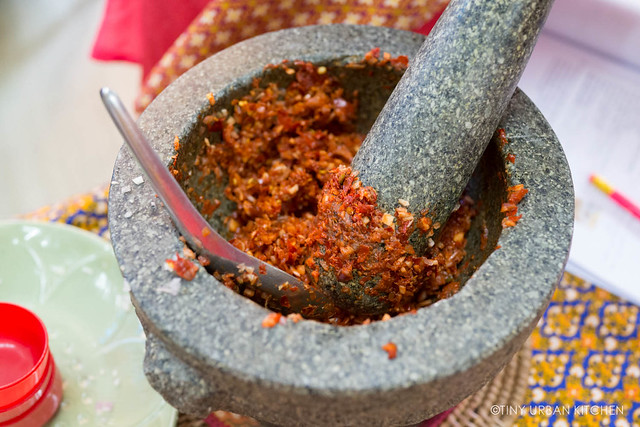
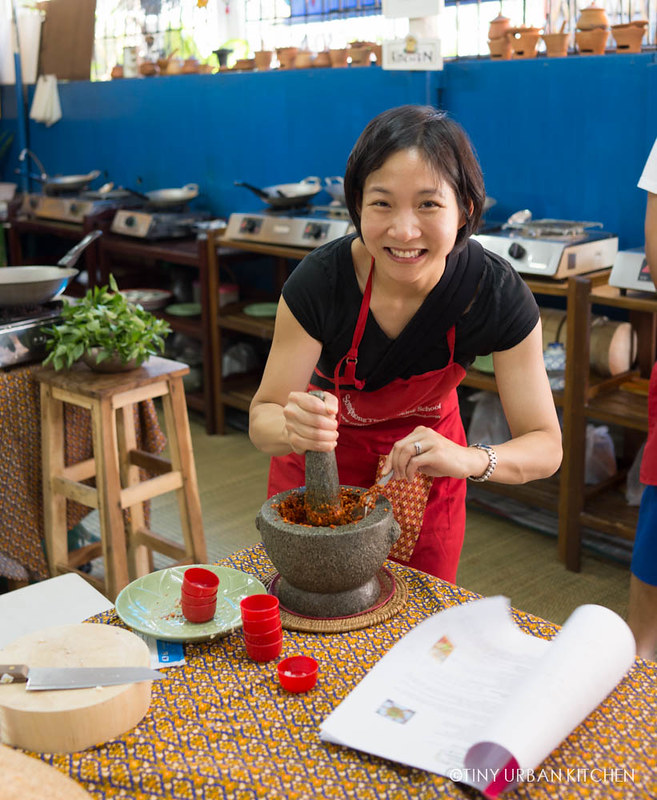
Though the steps for making the curry are not particularly difficult, they are time consuming. You must first measure out and prep (chop, seed, soak, etc) the large list of ingredients. Then, group by group, add the ingredients into a mortar and pestle.

The grinding is tedious.
_DSC1304\
We physically pounded away at this for about 10 minutes and didn't even come close to a smooth paste.

Theoretically, hand grinding will afford a smoother, more refined curry paste. However, most people these days rely on the food processor because it just saves so much time and energy and still creates a fine product.

Our pastes were whisked away and thrown into a food processor.
_DSC1306.jpg
Once the smooth paste was done (check out how much finer it looks now in the photo above!) we prepped our ingredients for chicken curry. Above, you can see fresh coconut cream, coconut milk, palm sugar, fish sauce, kaffir lime leaves (thinly sliced), and chicken breast meat.

If you can't get fresh coconut milk and coconut cream, Koy recommends just buying the small packaged carton of cream. You can make "milk" just by diluting the cream in half with water.
SompongRedCurry1.jpg
Saute one tablespoon of the curry paste it in a wok until it is fragrant. Add 1/2 cup of coconut cream and reduce the heat.
SompongRedCurry2.jpg
Wait until you see bubbles forming. This is the fat from the coconut milk separating out and rising the the surface. Add the chicken and stir fry until it is cooked all the way through. Add the rest of the coconut milk, fish sauce, and palm sugar.
CookingSomphong.jpg
If you can't get palm sugar around you, brown sugar or even white sugar are acceptable substitutes, though brown sugar is preferred. When shopping for a fish sauce, get a lighter colored bottle. Color is an indicator of freshness. Fish sauce darkens over time and becomes more fishy as it ages.
_X1C4400.jpg
As a final step, sprinkle thinly sliced kaffir lime leaves and Thai bird chili strips for decoration. If you want, you can optionally add a dollop of thickened coconut cream, which is just made by heating coconut cream up with some corn starch (about 2 tsp of corn starch per cup of canned coconut cream). Important note: dissolve the corn starch in the coconut cream at room temperature and then heat up. Otherwise, the starch will clump if added to a warm liquid.

Serve! Over rice, noodles, whatever!

Yum . . . SO good.

Recipes

Panaeng Curry Paste
_DSC1298.jpg

Ingredients
group 1
5 peppercorns
1/2 tsp roasted coriander seed
1/2 tsp roasted cumin seeds
1/4 tsp salt

group 2
1 tsp galangal, chopped
1 tsp lemongrass, chopped
1/2 tsp kaffir lime skin, finely chopped
1/2 tsp cilantro root (or use cilantro stems/leaves if the root is unavailable)

group 3
4 dried spur chilies, seeded and soaked
1 tsp chopped shallots
1 tsp chopped garlic

group 4
1/2 tsp shrimp paste (or anchovies)
1 tsp roasted peanuts

Pound group 1 ingredients (coriander seeds, cumin seeds, peppercorns and salt) in a mortar and pestle (or spice grinder). Add the group 2 ingredients (galangal, lemongrass, kaffir skin, cilantro root). Then add group 3 ingredients (garlic, shallots, and chilies). Add shrimp paste and pound until smooth. Finally, add peanuts and crush them in. Use a food processor if necessary to get the texture like a really fine paste.

Set aside.

Panaeng Chicken Curry
_DSC1313.jpg
serves 1 as a main dish, or 2 as an appetizer

Ingredients
70g boneless chicken, cut into bite sized pieces
1 tsp Panaeng curry paste
1/2 cup coconut cream
1/2 cup coconut milk
1 T red spur chili, thinly sliced (remove seeds!)
2 kaffir lime leaves, thinly sliced
1/2 T fish sauce
1/2 tsp palm sugar

Heat curry paste over medium heat until fragrant. Reduce heat and add coconut cream and stir until the oil separates out (you will see little bubbles forming). Add chicken and stir fry until it is cooked through. Add the coconut milk. Add fish sauce and palm sugar.

Sprinkle kaffir lime leaves and chilies and remove from heat.

Optionally add a dollop of coconut topping, made by heating coconut milk and corn starch together. Garnish with chopped chilies and kaffir lime leaves.

Enjoy!

Tuesday, April 9, 2013

Street Foods of Bangkok (Part II)

_X1C4503.jpg
This is the sixth post in the Thailand! travel series of my eats in Bangkok. Other posts include Thip Samai, Best Pad Thai in Bangkok? and Raan Jay Fai, Best Drunken Noodle in Bangkok, Maeklong Railway Market, Floating Markets (Damnoen Saduak). and Street Foods of Bangkok, Part I.

This is Part II of the Bangkok street food tour. If you're just joining us, definitely check out Part I of this post first before reading this.

It was raining, hard. This was supposed to be a walking tour, and the weather just was not cooperating at all.

Our tour guide Nushi told us to wait at the dock as she tried to hail a cab. As the wind whipped the water angrily around, we stood and marveled at the sheer force of the storm.

Ten minutes later, Nushi came with a cab. She looked wet, yet she was still smiling.

"Hop in."

As the rain pounded down onto the windshield, the cab inched along towards our final destination. Nushi chatted happily in Thai with the driver while we sat in the back.

Finally, about 10 minutes later, we arrived at our next destination.
_DSC1437.jpg
We were in a cafe in Silom, the business district of Bangkok. It is actually owned by the great grandson of King Rama V.  He likes Indian food a lot, and you definitely see a strong representation of that cuisine here. Thankfully (for Bryan's sake), there is also much other food to try, such as ice cream, bakery goods, and a lot of great Thai food. Our first small plate: green curry with pork. Though this is usually served with rice, this restaurant serves it with deep fried roti, a bread influenced by Indian cuisine._DSC1442.jpg
Because Bryan does not eat coconut milk (and thus skipped the green curry completely), we also ordered Isaan sour sausage, a fermented pork sausage from the northeastern part of Thailand. You commonly see this sold on the streets of Bangkok and it is usually served with sticky rice, which is the rice staple up north.
BangkokIceCream.jpg
This place had tons of really interesting ice cream flavors. We tried passion fruit ice cream, coconut sorbet, and tamarind sorbet. All of them were fantastic, bursting with the authentic flavors of their individual ingredients. My favorite was the passion fruit ice cream, but I think that's partly because I just love ice cream more than sorbet in general, and I love the flavor of fresh passion fruit, which was so pronounced in this ice cream.

We stepped outside. There was just one more stop, and it was within walking distance.

Amazingly, the sky had completely cleared up. I guess it was one of those fast moving storms. The sun was back out already, and the air was even thicker with humidity than I thought could be possible.

As we walked towards our last stop, Nushi said, "hold on, look! Fried bananas."
ThailandFriedBanana.jpg
There are often long lines at these popular street snack stands, where vendors sell freshly fried items such as sweet potatoes, mochi balls, and bananas. Luckily, perhaps because it was just after the storm, there was no line at this vendor's stand. We quickly stopped and picked up a bag of fried mini-bananas.

They were coated with some special sort of batter that reminded me of a funnel cake. Just imagine a sweet, crunchy funnel-cake-covered banana. It was seriously addictive (and I don't even like bananas!).
BangkokBakeries.jpg
For even more sweets, we headed to our last stop, a local bakery. Here we tried a lovely soft bread with pandan custard inside. We tasted a bun filled with sweet BBQ meat, not unlike Chinese chashu except that the outside bread is baked according to western methods. Finally, we sampled a western style cake topped with a traditional Thai style filling (made of coconut, perhaps?) used commonly in wedding desserts.

Finally, I (and Domo?) got to try Thai iced tea in Thailand. It was delicious, similar to the Thai iced tea I've had in America.

And then, just as quickly as it began, our 3-hour tour was over. We were stuffed, both with food but also with a rich wealth of knowledge.

Nushi had taken supremely good care of us, especially considering that a huge rainstorm came down right in the middle of our tour. We were quite grateful at how hard she tried to make us comfortable - everything from getting us umbrellas (from the Tonburi restaurant!), to waiting outside in the rain for 10 minutes in order to hail us a cab. Her English is excellent, and we really had fun on this tour.

If you're a newcomer to Thailand who absolutely has no idea where to start, I would highly, highly recommend taking the Bangkok Food Tour. They do a fantastic job.

The Details
This tour lasts about 3 hours and costs 1050 Baht (around $35 USD per person), which includes all the food. Although usually run in the morning leading up to lunchtime, you can arrange to have a private tour at other times during the day. Because of Bryan's work schedule, we ended up booking a tour from 2-5PM. We got our own private tour guide and paid a little extra for the convenience of the time and the private guide (3000 Baht for the two of us, around $50 USD per person).

It's easy to get to the meeting point, which is right inside the BTS Skytrain station Saphan Taksin.

Next up: fun fruits of Thailand and an introduction to the two cooking schools I attended!

Monday, April 8, 2013

Street Foods of Bangkok (Part I)

DSC00941.jpg
This is the fifth post in the Thailand! travel series of my eats in Bangkok. Other posts include Thip Samai, Best Pad Thai in Bangkok? and Raan Jay Fai, Best Drunken Noodle in Bangkok, Maeklong Railway Market, Floating Markets (Damnoen Saduak).

Thanks everyone for your outpouring of support for my wrist. It is slowly healing every day. I plan on looking into a few long-term options, such as speech recognition software or alternatives to the traditional mouse. Now, back onto our regularly scheduled program! :)

Where's the best food in Thailand?

If you ask anyone who has been to Thailand a few times, you'll pretty much get the same answer: on the street. Thailand is one of those countries where it's not uncommon to find a street vendor who has been perfecting his recipe for one particular dish for decades. In fact, I've already written about some of these places.

The people in Bangkok are obsessed about food, and it's all over the place. No matter where you live, just walk down the street and you're bound to find a street vendor selling some sort of food. Fresh fruit, deep fried snacks, noodle soups, and on and on . . . the streets of Bangkok are seriously a paradise for the food lover.

The amount of available street food was so overwhelming, I had a hard time figuring out where to start. Because I had only a set number of meals in Bangkok, I wanted to make the most of each meal. So, instead of just randomly trying street stalls around the city (and potentially hitting some duds), I decided to sign up for a walking street food tour with a company called Bangkok Food Tours.

We actually visited quite a few places (over a span of three hours!), so I will be splitting up our tour into two separate posts.
BangkokStreetFoodTour_Duck.jpgThis tour covered a neighborhood called Bangrak, one of the oldest parts of Bangkok. It sits just east of the Chao Praya river and was walking distance from our hotel. Meet our tour guide Nushi (young woman on the right side of the photo), who took us around for three hours sampling some fun foods.
_X1C4490.jpg
Our first stop was a famous restaurant that served a simple roast duck over rice. Originally inspired by Chinese cuisine, this dish has incorporated certain Thai influences, such as the use of honey in the  sauce.

The duck is free-range and therefore does not have as much fat under its skin. According to Nushi, this dish is by far the most popular dish at this restaurant, and people will come specifically for this particular dish.

It was juicy, flavorful, and most definitely had hints of sweetness from the honey. We both thought it was quite tasty, though quite familiar because it was so similar to Chinese food.
_X1C4492.jpg
It was during this first stop that Nushi pulled out the schedule showing us where we would be going for the day.

One thing stood out to Bryan.

2. Signature curry on egg

"I forgot to mention, I can't have coconut milk." Bryan told Nushi.

Even though not all curry in Thailand uses coconut milk, a large majority of curries do have some coconut milk inside, including the listed egg dish at the next stop. Nushi, thinking quickly, suddenly said, "I know. Let's skip the next stop. I'll take you to one of my favorite noodle joints instead."

Bryan loves noodles, so the trade-off was a no-brainer.
_X1C4501.jpg
In retrospect, what a great idea. This next "detour" stop became one of our favorites of the entire tour.

Now, it's most certainly not much to look at. In fact, this tiny little eatery sits in an alleyway between two buildings. Yes, Bryan is standing at the front of the restaurant. It isn't too far from the Catholic college nearby, and attracts tons of people at lunchtime, both foreigners from the college and locals alike.
TomYumNoodle.jpg
When I asked Nushi the name of the restaurant, she said, "I don't think it has a name. I guess people might sometimes call it Kuey Teow Kla, which means Hakkanese noodle, or Kuey Teow Silom."

It was like a Tom Yum Noodle soup, but made with chili jam.

"What's Chili Jam?" I asked Nushi.

"It's a sweet and spicy "jam" made out of shrimp paste, ground chili, palm sugar, and peanuts."

Yum. I started to wonder where I could get a hold of some.

Inside the soup, there were several different types of balls made out of fish, beef, and tofu. Fresh bean sprouts served to add texture as well a cooling contrast to the hot and spicy broth.
_DSC1424.jpg
The complex flavors of the broth were astounding - I'm not even sure I can name all the ingredients. It was definitely a pork bone based broth enhanced with various chilies, lemongrass, fish sauce, and possibly lime? The fresh rice noodles were delicious as well. Even though we both got pretty big bowls (I would hardly call these tasting portions!), we both came close to finishing everything. This is in spite of knowing had several, several more stops to go.
_X1C4503.jpg Next, we boarded a boat and crossed the river to the Tonburi neighborhood. The clouds were starting to look a bit ominous at this point.

I turned to Bryan, "maybe not such a good day for a walking tour!"

He shrugged. "We'll see" he said.
Tonburi.jpg
After getting off the boat, we walked straight down the narrow alleyway leading away from the dock. On the right we saw a simple, bright green counter._X1C4504.jpg
We were eating at an odd hour (around 3PM) mostly because it was the only time we could fit in a tour due to Bryan's work schedule in Thailand. Typically the place is packed, but we were lucky to have the whole place to ourselves on an ominous, stormy Friday afternoon.
_X1C4509.jpg
We were here to sample some specialties from Northeastern Thailand, also known as Isaan cuisine. The menu was written entirely in Thai here, so I was thankful for Nushi's guidance in helping us pick out some choice plates.
_DSC1436.jpgSom Tam is a classic papaya salad that consists of young, green papaya pounded together with carrots, dried shrimp, and peanuts. The dressing is sweet, savory, sour, and spicy with flavors coming from fish sauce, lime juice, palm sugar, tamarind juice, and lots of chilies! This particular one was very spicy and packed full of flavor. We were both sweating while eating it, but also enjoying it quite a bit.
_DSC1430.jpgNam Tok Moo is a salad made by tossing together pork with roasted rice powder, mint leaves, chili, and shallots in a flavorful dressing made from lime juice, fish sauce, and sugar. Again, I love how Thai cuisine achieves that perfect balance of savory, sweet, sour, and spicy. This dish was fantastic and we ate as much as we could handle (yes, it was spicy!!)._DSC1428.jpgFinally, we tried Yam Pla Duk Foo, a fascinating dish that consists of catfish that is first grilled, deboned, and then deep fried to form this light, airy, almost weightless cake. You eat it with this vibrant sauce made with green mangoes, shallots, chili, palm sugar, and lemon juice.

This tiny hole in the wall was another one of our favorites, and definitely a place that would have been difficult for us to find without a guide. We loved the northern style dishes, which we found to be quite different from most of the Thai food we see in America.

Suddenly, KABOOM!

And it started to pour.

Nushi was kind enough to ask the restaurant whether we could borrow some umbrellas.

"I'll bring them back later."

We ran back down the narrow dock towards the boat. Even though lightening was flashing across the sky, the boats continued to run. We ran to safety onto the boat as it pulled away from the dock back towards the Bangrak side of the river.

Next Up: Part II of the "Street Foods of Bangkok" Tour, where we will explore fried street snacks, some more Isaan fare, unique local ice cream flavors, and some fantastic desserts.

Stay tuned!